Monday, April 30, 2012

Leet Noobs: The life and death of an expert player group in World of Warcraft.


I recently read a book by Mark Chen: “Leet Noobs: The life and death of an expert player group in World of Warcraft”. A light reading, very pleasant narrative that gives a description of the gaming practices within a group. With digital media practices being a priority for many researchers, educators and designers, looking at practices and norms within social, online gaming spaces can be particularly fortuitous for understanding human learning and behavior.

This book provides an ethnographic description of how practice looks like in World of Warcraft (WoW), in a guild of 60 players who take up identities, learn the context and their teammates through game play. Chen spent over 10 months collecting data, ending up with about 600 hours of chat and about 80 hours of video data. In my opinion, this is a particularly interesting research task, as it deals with a context that is constantly in flux, there is no control, and there is great uncertainty regarding what a researcher can find.

One of the strongest features of this book is that it provides a holistic, and at the same time detailed, elaborated manner that a group came together and worked, followed particular norms and practices. “Well played”, “well researched”, and “well described” to the audience. The narrative is particularly powerful in that it provides an inside view of the practices and interactions: from designing the guild tabart, to leveraging differences between the various expertise levels, to raiding and frustrating moments.

Reading this book helped me understand what types of interactions I wanted to reinforce through my own research game designs. Interpersonal relations provide feedback and make ideas powerful. It was exciting for me to see how experts in the game came to become novices (in a sense) again and relearn norms and practices in the game. Players realized that effective continuation within the game would depend on mutual work, and therefore, teaming up with people that worked on the same quests seemed to be the most effective way of advancing. The various vignettes that Chen provides document the ways activity is organized among participants how things emerge throughout the game play.

Chen shows that expertise in a space depends on the social practices that players go through and the relationships developed through the limitations they have to deal with. Being part of a group is heavily dependent on “access to the micro-cultures” (p.168) of activity. In the particular study, negotiations within the group defined the level of trust, as well as the nature of the role members had for effective participation.

Structurally, this book does not follow traditional paths… After an introduction of the main terms Chen describes the process of leveling up his character. In the first chapter, he describes how everyday practice looks like in WoW, in relation to social and cultural elements. Then, he elaborates on how players communicated and coordinated while raiding and explains what is needed for a group to succeed (trust and conflicts among players). Later on, the reader receives a description of how combats can take place in WoW, as well as a picture of the relationships and practices within the activity system of the game. The last chapter is a documentation of how the group of participants faded.

I highly recommend this book to whoever wants to understand online gaming practices and have an ethnographic understanding of how one can organize research around decomposing such complex systems and activities. To whoever likes learning about games and social practice, and to whoever likes the adventures of diving into the world of games and research! 

Follow Mark Chen on Twitter: mcdanger

Reference: Chen, M. (2012). Leet Noobs: The life and death of an expert player group in World of Warcraft. New York: Pete Lang Publishing, Inc. 2012. Pages: 200.

Wednesday, November 9, 2011

My future, augmented reality tattoo...


WHERE THIS STARTED FROM... A couple of days ago Dr. Curt Bonk had a very interesting guest speaker in his online class on “The World is Open”. Craig Kapp from NYU talked about mobile learning, digital books, augmented reality, and demonstrated come really cool examples of his work (Title of the talk was: “Visualizing the Future: How Augmented Reality can empower faculty, inspire students, and bring ideas to life in the classroom.” Click HERE if you want to watch the full talk).
The augmented reality idea is fascinating to me, as all the creative and inspiring ideas one has, can be animated… How exciting is it to look at a cardboard an see a simple drawing, but when you look at it through your mobile device, it is something totally different: Little red riding hood tale coming to life, animals in the jungle running around, or even your creative imaginations!
THE CONSEQUENCES OF THIS TALK... So my question that sparked the idea for what you are reading now is whether one can create an augmented reality tattoo that others can just see as a simple square or something, but then when they look at it through their mobile device, the tattoo has… “flesh and bones”… literally! People’s creative imagination is endless. Such a tattoo can be “re-programmed” to represent a different idea/shape/design… If I had such a tattoo, I would never get tired of it! Seriously! I mean, we adopt different identities based on our interactions with others, we transform our dispositions about the world, life, etc. I find this to be an alternative way of creative expression that portrays identities, moods, feelings, etc in a very dynamic way.
How such ideas can shape the ways we look at creativity in daily life? How can such creations represent one's creative ideas? Where is this evolution of digital media taking us? And how are such opportunities influence how we express ourselves, ideas, messages, or stories? These questions are not explicit to the idea of a tattoo, but refer to general concepts of creativity with digital media. What are the limits? Or are there limits to creative expression?
WHERE THIS IDEA IS TAKING ME TO.... Body as an augmented reality platform... Is such a thing even possible? Well, it looks like it is! Check THIS out! I have to look into this idea more, but I think I want such a tattoo… yes, a square that means nothing, but really augments the reality I want to create through it. Here is the YouTube video of a flying dragon tattoo. And here is another awesome, singing animation tattoo.
I think I’m off to creating my Augmented Reality tattoo… ;)

Monday, March 28, 2011

Another, more complicated concept map

"The field of media arts presents many unique opportunities for educators and researchers wanting to encourage active learning, make the schooling curriculum relevant to youths’ out-of-school interests, and teach youth how to communicate through a variety of multimodal discourses" (Peppler, 2010, pp. 29-30).
This week I worked on making my concept map even more complex. A new layer of connections contributes with information on creating with media arts and tools in order to give answers to the question "what is the role of arts, computation and digital creativity in new media"? I focus on Peppler's work on media arts, on Reas's tools and on Dewey's ideas, as well as on Sefton Green's creativity ideas. I also draw from my own experiences with my studio projects so far.

You can view an enlarged picture of the concept map HERE.

The role of the arts, computation and digital creativity is important for new media. Peppler's paper showed that impact at the Computer Clubhouse in Los Angeles. As an example, that study highlights the importance that freedom in creativity can have in the ways new media are explored, used and also in the ways they convey messages. It seems that this freedom allows experimentation and exploration within the areas of new media, and people learn through alternative ways of using tools. She promotes the ideas around learning in and out of school, and new media being the diode to such creative learning practices. Scratch is a tool that allows for experiential, experimental and active creation and learning.

Dewey was a great advocate of experiential learning and viewed the arts as an experience through which we grow our identities and knowledge. Along those lines, Reas and Peppler both reinforce this argument with their work. Reas proposes new ways of communicating with the computer, related to programming languages and authoring tools. He proposes Processing, an open source software that allow users to create easily.

Our understanding of new media derived through the ways they are used in daily life. We all design with new media, we share our creations and reflect on them. Creativity is key to how designs are reflected, and how they are being taken up by the audience. The Scratch community is a context where designs are evaluated. Designers publish that work and the community views, engages with the design, rates it, etc. This becomes a process of reflection, as members view and understand the elements that a project has that make it such.

For our designs studios, this is another opportunity for exploration, experimentation and active learning. We take the initiative to give flesh and bones to our idea, and then we share it with the community. I personally learned a lot about the role of new media for learning, as well as about the affordances that new media provide for creative expression and learning. For example, atmosphir was one of the tools that make the greatest impression to me. It is dynamic, and powerful tool that allowed me to experiment with an idea I had, develop it and share it. Whether one is a digital native or a digital immigrant, people can use them in the same ways. Literacy in new media becomes significant in such cases of authoring and digital production.

Tuesday, March 22, 2011

Experimenting with atmosphir

I created a game level on www.atmosphir.com and I called it "Cake marathon". Atmosphir is a game design platform that allows users to create their own game levels and share them with the online community. I find the particular kind of media to be a wonderful tool for creative expression. Designers (users) can create whatever they want, can provide whatever experiences they like and design different difficulty features for their audiences. Creativity is for me a major characteristic of good digital media. The affordances of the particular medium fascinated me because I could manipulate everything in ways that other media had not afforded so far. For example, I could easily lay out the blocks with just one click or by dragging my cursor around the grid. I could easily add and remove objects, an action that would be difficult to obtain unless someone had advanced programming skills.

Screenshot from my cake marathon. Click on it to access and play the game (also at: http://www.atmosphir.com/level/show?id=420532)

For my example, I created a level through which players must jump across several cake pieces, cookies, orange and kiwi slices, as well as a candy bridge in order to reach the final flag. It seems very easy, but when I tested it, even I had trouble getting across! I think the role of the arts and creativity is major in media for the 21st Century. It is not only colors and graphics that make digital media so much better and attractive, but also the opportunities for expression they provide. Creativity in the particular context does not mean colors and graphics, indeed. Creativity seems to be measured through the difficulty levels and the designed experiences users come up with. I find this to be a very powerful property because it comes to redefine the ways we perceive creativity in online spaces.

Sunday, February 27, 2011

Multiliteracies in the 21st Century


“Defining what counts as “valid or legitimate or desirable” forms of understanding and creativity in current contexts will certainly continue to be one of the challenges.” (Buckingham, 2005, p. 149, in Greenhow, 2009, p. 249)
My additions to my concept map this week are in orange color... I found myself making even more connections and mixing this week's terms with the previous ones, which i really enjoyed! Click on the image to go to the actual concept map.


New media is about multiliteracies; it involves a (hidden) pedagogy that emphasizes on more than the ability to use language as a means of communication, but also text, music, pictures, animations, etc. It is sensitive to the cultural context one functions in and the community that speaks to particular pieces of work (e.g. when someone creates an animation about the planets, that might be speaking to the community of scientists, leisure artists, etc., depending on the character of the creation). There is a dynamic relationship between the different modes of literacies, as one can be combined with other modes. The result is a rich collection of projects and information that provide multiple perspectives, feelings and tones.

Perceiving the participants of the 21st century as being active, new media embrace diversity and freedom of speech. There are no boundaries in the way one can express themselves and there is always a means of communicating different messages. The result of the use of multiliteracies is a dynamic social change and transformation. Identities are constantly changing, being shaped and aligned with different aspects of new media. Digital immigrants, according to Prensky, are speaking the outdated language whereas digital natives seem to be talking the language of technology, of new media and can use technology naturally, as part of their lives (Prensky, 2001). In this sense, new media are a sine qua non of a person’s development in the 21st century.

I believe that new media, being so powerful, can change the ways we think about learning and professional development. Creativity in this sense becomes central in the ways that people learn and become productive in their contexts. The hierarchies that used to structure the ways people participate are no longer stable, and the power has started shifting from the heads to the participants; everyone has a voice and everyone participates in the construction of their learning. Our participatory culture, as Jenkins (2004) characterizes it, is being shaped from and shapes new media.

Tuesday, February 22, 2011

Another concept map... on New Media

“All existing media are translated into numerical data accessible for the computer. The result: graphics, moving images, sounds, shapes, spaces, and texts become computable, that is, simply sets of computer data. In short, media becomes new media” (Manovich, 2001, p.25).
I agree with Manovich when he says that this has changed the character of media and computer. Whereas media were the still pictures, the roll that showed a picture on the white screen, now it is a representation of powerful ideas, and whereas the computer was just a processing machine, not it is a synthesizing tool through which those powerful ideas get flesh and bones. The computer is getting smarter and smarter in terms of what tasks we can perform with it. Animations can give as fictional or as realistic feeling as one wishes and music can be remixed in every possible way. Youth, adults, and even kids can be programmers of the computers and create complex designs that would not be possible without the interaction with a computer (e.g. Scratch).

I found the Principles to be very informative; indeed Numerical representation, Modularity, Automation, Variability, and Cultural transcoding are characteristics of new media. Everything is digitized and can be represented with an algorithm, they consist of multiple elements, such as sound, images, movement, etc., and can be connected with each other in multiple levels and one can create multiple versions of a product representing the meaning coherently.

I think that what’s new about new media is the kinds of affordances that one can exploit and also the levels of creativity one can express. This novelty started creating a new, pop-culture that is growing very fast. My concept map started becoming complicated, with all the connections I am adding to it. Below is my concept map. Click on it to navigate to the actual website:


(http://www.mywebspiration.com/view/757319a34fa4 )

Exploring Atmosphir

"Atmosphir runs on imagination. And Unity." (www.atmosphir.com)

Friday, January 28, 2011

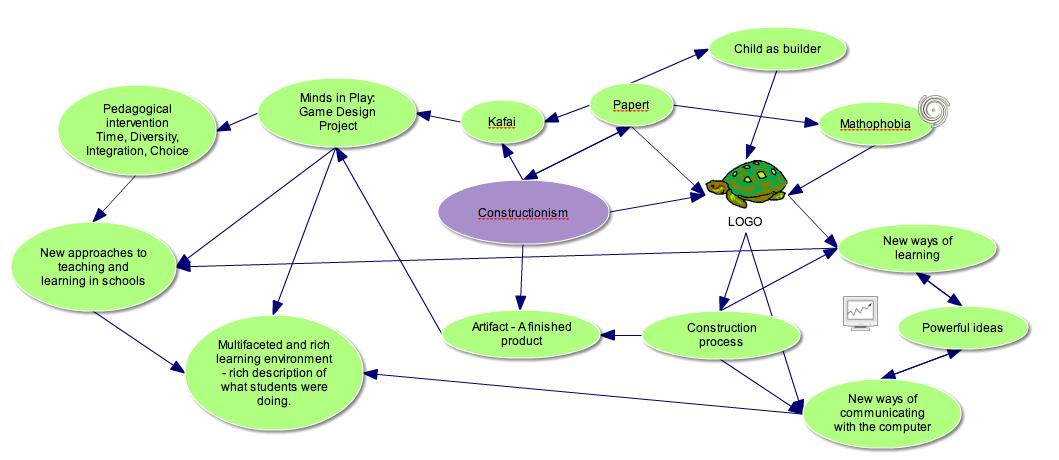
A concept map on Constructionism


“The really interesting problems in education are hard to study. They are long term and too complex for the laboratory, and too diverse and non-linear for the comparative method. They require longitudinal study of individuals” (Hawkins, 1973, p. 135, Quote in Streefland, 1991) [italics added] What Hawkins called the “really interesting problems in education” are the ones that focus not only on the product, the outcome of the learning, but also on the processes that describe the different paths taken, extended, or abandoned by the learner (in Kafai, 1995, p.37).

I am starting my blog with the above quote because I think it captures the meaning and purposes of Constructionism, as reflected on my concept map. Considering the child to be the builder, the construction process a student goes through opens new ways of learning and of communicating with the computer, as those interactions afford powerful ideas to emerge and develop. Positioning the child as the builder, Papert created LOGO (Papert, 1993), a tool that enables students to create their own products by being able to programming the computer, instead of the computer programming them. As he stated, it is "possible to create computers so that the process of communicating with them is natural. Also, learning to communicate with the computer might change the ways other kinds of learning occur" (Papert, p.6).

On my concept map, I have, of course "Constructionism" at the center and then Papert and Kafai, that are tightly connected with the term and with learning in new media. Papert talked about mathophobia (fear for learning math) and explained that LOGO could afford new ways of learning math. Gong through the construction process, students are able to view the results of their programming. At the time this book was written, LOGO was a radical means of learning, that would open new doors towards learning and interacting with the computer (as we see nowadays). Those powerful ideas could be further developed and bring to the surface new ones.

At the end of the production process, there is an artifact, a constructed product. Kafai (1995) describes "Minds in Play", a game design project that constituted a pedagogical intervention. Time, diversity, integration, and choice were some of the characteristics of the multifaceted and rich learning environment. Through a rich description of what students were doing, new approaches were revealed to teaching and learning in schools.

Constructionism describes one view of how people learn, as Kafai and Papert describe. From my own experiences I can see how constructionism can explain many of the projects I work on. Even for the online class that I am teaching through a computer game, I can see how constructionism applies; my students participate online, collaborate and interact with their peers and the environment and they work towards specific goals that are achieved through the artifacts they produce.

Saturday, January 22, 2011

Playing with Scratch

I started playing with Scratch about a year ago... Two days ago, I downloaded it again and I realized that I wasn't able to remember much! So I started experimenting with it again. I looked through all the options I had with the controls, the sounds, movements, backgrounds... I started with the yellow cat.. :) and then I added a butterfly... I happily discovered that I could have her say hello through the controls and also change her size from the buttons above the white screen.
Soon, Scratch and the butterfly were moving towards the right part of the screen and they were saying "Hello"! Easy task so far... How about adding some background? I searched my computer and found a picture from an online project I worked on... ok, imported... that was easy too! The process of playing with the controls and the commands was a bit challenging. I think it needs some practice though, until one can manage to be fast enough in programming animations on this (it was hard to figure out how to change the background after one clicks the space bar...).

I can definitely see the theory behind this tool. I can see the constructivist elements that we talked about in our last week's online class. Interacting with the tool, and at the end you have a product, an outcome, that is the result of your personal (in this case) learning process. I think I need to explore more those properties of Scratch in order to fully understand how it works. It is indeed a complex tool that takes time to master.

After looking at other projects on the Scratch site (it is amazing how creative children can be!!!) I wasn't confident for uploading it on the site... so I took some screenshots of the various modifications I made on my first project. I am hoping that throughout the next few weeks I will be able to have a decent animation project to share with the larger community!

Wednesday, December 29, 2010

How useful can an article be?

So lately I've been studying and studying all those theories, frameworks, methodologies etc, as part of my PhD requirements. Today, I have reached a "DUHHH" moment just by reading this article on learning and case based scenarios...

The author said NOTHING new! 30 pages, all examples that are self explanatory. Of course learning by doing is useful! Of course we learn through experiences better than just reading abstract knowledge... Why does it have to be so repetitive? Or is it just me studying too much? :P

Monday, December 27, 2010

New website

At last, I have my new website up and running... I wanted to have it done a couple of months ago, but.... oh well, better late than never, right? :)

I think it looks ok... of course, additions will come as time passes. Hopefully, this will be a good year, with exciting accomplishments...

Wednesday, July 14, 2010

How Role-Playing-Games can enhance effective knowledge transfer in marketing situations.

Within the latest two decades, computer games and virtual worlds have occupied a significant part of everyday life. Primarily for fun, people play, from strategy games, to action, racing, to shooting games. Virtual worlds have generally become spaces where people meet for virtual communication and other interactions. Specifically role-playing games (RPGs) are nowadays of the most powerful virtual spaces that afford fortuitous interactions between the player/avatar and the environment.

At the same time, there is significance rise in the expansion of games in formal educational settings, training contexts, and other learning and professional development spaces. This blog illustrates a model for effective knowledge transfer training in marketing settings. Specifically, it focuses on the relationship between the person and its interactions with the environment and its affordances in order to understand marketing scenarios that can occur in real life.

The increasing value of RPGs lies in the fact that they immerse players in narratively rich experiences; they take up roles and are active agents of change in the virtual context. For example, by taking up the role of a reporter, marine biologist, doctor, executor, shooter, seller, etc., in a RPG game, players can interact with avatars and acquire objects, that push the narrative forward in ways that every choice becomes significant for the continuation of the story (Gee, 2003, Barab et al., 2010). If the player chooses to invest a lot of their in-game money to buy a big amount of products, they might lose the game, as the real-life “laws” will apply; the player will run out of money if there are not enough buyers to buy the products, the bank might charge more interest, etc.

It is evident that RPG games can successfully simulate real life situations; the effects of certain causes are expected and the consequences are realistic, as much as the virtual setting seems to be. This realistic simulation seems to be what enhances knowledge transfer, especially in educational settings. There has been a lot of talk lately about the educational value of games and this exact simulation of real life can afford learners to assimilate knowledge more naturalistically and therefore, transfer it. The fact that learners can experience the effects of their actions is crucial when they are to rearticulate their knowledge to a new setting because they are equipped with the knowledge, and at often times with the skills to respond to new problems.

As learning is considered to be lifelong, and as companies aim to train their employees to respond to different problems, it is significant that they adopt adequate practices for their employees’ professional development. In the business world, training is a significant component for success and growth. A successful company has well-trained employees that can respond to the demands of the clients, and those of the company in extend. However, training does not happen once; on the contrary, a successful company provided opportunities for professional development and training at frequent times.

Either face-to-face, or online, training sessions aim at introducing new trends, providing solutions to newly raised problems, as well as ensuring their trainees’ successful course. As games are becoming a new trend for learning, it seems vital to adopt such practices in the training sector. Specifically, marketing is a business field that requires fast reactions from the seller who promotes a product, and competes with others in the field. At often times, being able to react quickly and provide the client with what they need can lead to successful marketing strategies by having the competitive advantage in the market. Training the marketers for dealing with such problems can significantly raise the sales of a company. A model for such training is proposed in this paper, aiming as identifying the components of a successful virtual training for marketing businesses.

As shown in Figure 1, the model emphasizes on the interactions between the trainee, the context (the virtual world of the RPG game), and the content (several strategies that the trainee is exposed to in order to resolve the problem in the gaming situation). The transactive relationship between these three components is crucial for effective knowledge transfer in real life settings, as the strategies will be applied in the narrative provided in the RPG by the trainee, in their attempt to respond to several simulated situations they are likely to encounter in the future.


Extending this general form of the model, there are other factors to consider in the overall process, like the trainer and their role, the nature of the interactions between the marketers and the buyers (these can be virtual characters in the game). Also, two factors that derive from this model, and that need to be taken into consideration are the legitimacy and the consequentiality of the components’ relationships. Since RPGs provide immediate feedback to the players’ actions, the design of an RPG for the particular purposes must have the same affordances so that the trainees’ agency is reinforced. The trainer should monitor the overall process and challenge the trainees’/ players’ thinking. This way there will be more critical engagement in the overall process.

In order for an action to be legitimate, it must satisfy the rules of the game. Therefore, an action is legitimate if the player successfully completes it and moves further in the marketing training process. For example, if creating a campaign for a product that has successful outcomes for the uptake of a product, then that action is considered to be legitimate and the consequences are encouraging and provide fertile ground for the next steps. Upon legitimacy, consequentiality is enhanced as the player becomes aware of their actions and the consequences a strategy might have in the marketing process.

All these components contribute to acquiring the knowledge and skills to respond to real life situations. Being able to realize and understand the consequences of an action in marketing, the trainee will be more ready and equipped to respond to projects and problems in the marketing process, as they will have experiences similar virtual experiences and they will be able to avoid possible mistakes. Associating similarities between virtual and real life scenarios enhances effective knowledge transfer, and as we base our actions, usually to our prior experiences, it is more efficient to respond to the demands of the market and come up with the right strategies for successful marketing.

In applying the particular model, trainees can practice their company’s strategies in a virtual context and understand how they work is different situations. For example, the RPG can provide a series of scenarios from a database that indicate successful applications of strategies in specific situations. The same can happen for unsuccessful applications of strategies and then provide opportunities for reflections and discussion around what could have gone wrong, or what could have been done differently. Further, this model supports safe experimentation of several strategies in various situations, as mistakes do not have real consequences and the immediate feedback provided trains for adequate responses to marketing scenarios.

This type of training can optimize the marketing world in terms of training the employees. Having virtual contexts to use, businesses can direct their employees for professional development at any time – the employees can have access to the training sessions at any time as well. The quality of training could be potentially optimized through this model, as trainers will focus more on the aspects of consequentiality, legitimacy and the interactions that shape the dynamics if the model’s system and knowledge can be more effectively transferred in real life situations.

Overall, this paper has proposed and described a model for training that situates the trainees in a context and immerses them in a simulation of real life, a combination that affords rich interactions that enhance better understanding of how marketing strategies can be applied and work in specific situations. The overarching outcomes of such naturalistic immersion is the effective knowledge transfer in real life and in extend the more successful application of strategies in the world of marketing.

Wednesday, June 16, 2010

ITHAKA by Constantine P. Cavafy

As you set out for Ithaka
hope your road is a long one,
full of adventure, full of discovery.
Laistrygonians, Cyclops,
angry Poseidon-don't be afraid of them:
you'll never find the things like that on your way
as long as you keep thoughts raised high,
as long as a rare excitement
stirs your spirit and your body.
Laistrygonians, Cyclops,
wild Poseidon-you won't encounter them
unless you bring them along inside your soul,
unless your soul sets them up in front of you.

Hope your road is a long one.
May there be many summer mornings when,
with what pleasure, what joy,
you enter harbors you're seeing for the first time;
may you stop at Phoenician trading stations
to buy fine things,
mother of pearl and coral, amber and ebony.
sensual perfume of every kind-
as many sensual perfumes as you can;
and may you visit many Egyptian cities
to learn and go on learning from their scholars.

Keep Ithaka always in your mind.
Arriving there is what you're destined for.
But don't hurry the journey at all.
Better if it lasts for years,
so you're old by the time you reach the island,
wealthy with all you've gained on the way,
not expecting Ithaka to make you rich.

Ithaka gave you the marvelous journey.
Without her you wouldn't have set out.
She has nothing left to give you now.

And if you find her poor, Ithaka won't have fooled you.
Wise as you will have become, so full of experience,
you'll have understood by then what these Ithakas mean.

Sunday, May 9, 2010

Blended Learning

I am participating in a blended course that aims at advancing instructional methods and investigating the dynamics between the participants, the reactions to the tools as well as the motivation. During the first steps of the course, the issue of incorporating blended learning in academic institutions was discussed.

The academic institution I work at provides good opportunities of teaching through innovative methods. For the past year, I have been teaching an online class to undergraduate, pre-service teachers, where the contend was on learning theories and ways to apply them in the class to improve instruction. Next year, I will be teaching the same class, but in a different format; I am planning to use blended methods, similar to the ones we briefly talked about. This would involve face-to-face, and online meetings, but through a 3D virtual world, where people can see their virtual characters and interact synchronously.

Indiana University is an institution where several instructors apply blended instructional practices, involving videoconferencing, skype meetings, 3D in-game meetings, as well as face-to-face meetings throughout a semester. I believe this is a great way of incorporating teaching practices in diverse settings, as it can facilitate learning in various ways, and in accordance to lea learners' needs. For example, when we teach our pre-service teachers about ways of incorporating technology, it is necessary to expose them to the different types of technology, so that they can experience how they work and become confident in using them later on. Our society, being technologically oriented for a while now, demands such use of technology in classes. Teachers need to be prepared to respond to such a demand.

It seems, however, that some learners do not react positively to such innovative instructional practices. Not being tech-savvy, many students enter courses hesitant about whether they can keep up with the pace, the nature and the challenges of a blended course. This is where the instructor's role becomes significant; we need to provide all kinds of support to our students and scaffold them throughout the course so that they become confident, and competent. Also, the instructor should provide a safe environment where experimentation should be promoted. I personally really like this method because I believe it provides opportunities to students to discuss their thoughts at any setting they feel comfortable.

Thursday, April 29, 2010

Friday, April 16, 2010

Habermas and games? Hmm...

From an ontological lens, the objective, subjective, and social realms that Habermas elaborates on are not very different in the two worlds, except from the type of participation that takes place in each context (virtual and physical participation). Like in the physical world, norms are being established within virtual spaces that support the use of symbols for effective communication. Symbols in both physical and virtual groups are associated with implicit meanings, which are usually the same in both kinds of contexts. Therefore, for example, the handshake is a symbol of salutation (an introduction) in the physical world; when we meet new people, salute people that we know, etc, we tend to shake hands. Similarly, when a person joins a guild in World of Warcraft (WoW), the virtual handshake is a symbol that serves the exact same purpose, with the same legitimate way. It is implied by the cultural norms that people in a group can use the handshake to salute. In virtual worlds, this is implied only when the design allows it. If the designer does not create the affordance of a virtual handshake, then the gesture does not exist and the virtual participants create a new norm for salutation to serve their purposes.

Wednesday, April 22, 2009

Monday, April 20, 2009

Games, simulations and learning

I just found this interesting... Are game educational? Can learning be fun? Can we understand something without direct experience and without active involvement?

Hmmm... http://net.educause.edu/ir/library/pdf/ELI3004.pdf

Thursday, April 9, 2009

Piaget's development and learning...and 2 examples!

So this is how I understand Piaget's description of learning and development for knowledge...It seems pretty clear to me...but pretty blurry at the same time!

For Piaget, development for knowledge is related and associated with the individual’s physical development, and certainly comes before learning, and also explains learning (through the stages of development that he describes). Development is a process that knowledge is based upon, for completeness and structure. On the contrary, learning occurs through situations (instead of physical progress), and therefore, it is not spontaneous (as is development). It concerns situations, problems and structures. Without development, learning cannot occur, since there need to be the adequate mental structures that will host learning (the structures develop in 4 stages; sensory-motor, pre-operational representation, concrete operations and operations on abstract ideas).

For example, learning to ride a bike requires first physical development (body and brain-mental structures) before the individual manages to cycle effectively. Apart from the body parts that need to be developed, the brain developed is crucial for the individual’s perception of speed, depth and coordination. Without these schemata developed, it would be impossible to learn how to ride a bicycle effectively. Similarly, when the case is learning to read, there needs to be physical development prior to learning, since the child would have to the function of eye coordination (something that would occur between the sensory-motor and the pre-operational representation stage). Once the physical development is done, then learning can take place effectively, and the student can manage to read.