Sunday, February 27, 2011

Multiliteracies in the 21st Century


“Defining what counts as “valid or legitimate or desirable” forms of understanding and creativity in current contexts will certainly continue to be one of the challenges.” (Buckingham, 2005, p. 149, in Greenhow, 2009, p. 249)
My additions to my concept map this week are in orange color... I found myself making even more connections and mixing this week's terms with the previous ones, which i really enjoyed! Click on the image to go to the actual concept map.


New media is about multiliteracies; it involves a (hidden) pedagogy that emphasizes on more than the ability to use language as a means of communication, but also text, music, pictures, animations, etc. It is sensitive to the cultural context one functions in and the community that speaks to particular pieces of work (e.g. when someone creates an animation about the planets, that might be speaking to the community of scientists, leisure artists, etc., depending on the character of the creation). There is a dynamic relationship between the different modes of literacies, as one can be combined with other modes. The result is a rich collection of projects and information that provide multiple perspectives, feelings and tones.

Perceiving the participants of the 21st century as being active, new media embrace diversity and freedom of speech. There are no boundaries in the way one can express themselves and there is always a means of communicating different messages. The result of the use of multiliteracies is a dynamic social change and transformation. Identities are constantly changing, being shaped and aligned with different aspects of new media. Digital immigrants, according to Prensky, are speaking the outdated language whereas digital natives seem to be talking the language of technology, of new media and can use technology naturally, as part of their lives (Prensky, 2001). In this sense, new media are a sine qua non of a person’s development in the 21st century.

I believe that new media, being so powerful, can change the ways we think about learning and professional development. Creativity in this sense becomes central in the ways that people learn and become productive in their contexts. The hierarchies that used to structure the ways people participate are no longer stable, and the power has started shifting from the heads to the participants; everyone has a voice and everyone participates in the construction of their learning. Our participatory culture, as Jenkins (2004) characterizes it, is being shaped from and shapes new media.

Tuesday, February 22, 2011

Another concept map... on New Media

“All existing media are translated into numerical data accessible for the computer. The result: graphics, moving images, sounds, shapes, spaces, and texts become computable, that is, simply sets of computer data. In short, media becomes new media” (Manovich, 2001, p.25).
I agree with Manovich when he says that this has changed the character of media and computer. Whereas media were the still pictures, the roll that showed a picture on the white screen, now it is a representation of powerful ideas, and whereas the computer was just a processing machine, not it is a synthesizing tool through which those powerful ideas get flesh and bones. The computer is getting smarter and smarter in terms of what tasks we can perform with it. Animations can give as fictional or as realistic feeling as one wishes and music can be remixed in every possible way. Youth, adults, and even kids can be programmers of the computers and create complex designs that would not be possible without the interaction with a computer (e.g. Scratch).

I found the Principles to be very informative; indeed Numerical representation, Modularity, Automation, Variability, and Cultural transcoding are characteristics of new media. Everything is digitized and can be represented with an algorithm, they consist of multiple elements, such as sound, images, movement, etc., and can be connected with each other in multiple levels and one can create multiple versions of a product representing the meaning coherently.

I think that what’s new about new media is the kinds of affordances that one can exploit and also the levels of creativity one can express. This novelty started creating a new, pop-culture that is growing very fast. My concept map started becoming complicated, with all the connections I am adding to it. Below is my concept map. Click on it to navigate to the actual website:


(http://www.mywebspiration.com/view/757319a34fa4 )

Exploring Atmosphir

"Atmosphir runs on imagination. And Unity." (www.atmosphir.com)

Friday, January 28, 2011

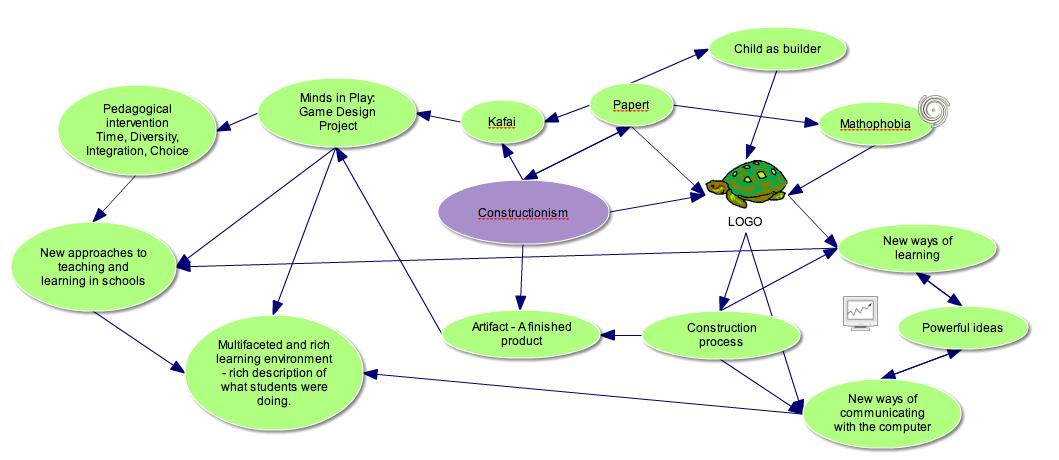
A concept map on Constructionism


“The really interesting problems in education are hard to study. They are long term and too complex for the laboratory, and too diverse and non-linear for the comparative method. They require longitudinal study of individuals” (Hawkins, 1973, p. 135, Quote in Streefland, 1991) [italics added] What Hawkins called the “really interesting problems in education” are the ones that focus not only on the product, the outcome of the learning, but also on the processes that describe the different paths taken, extended, or abandoned by the learner (in Kafai, 1995, p.37).

I am starting my blog with the above quote because I think it captures the meaning and purposes of Constructionism, as reflected on my concept map. Considering the child to be the builder, the construction process a student goes through opens new ways of learning and of communicating with the computer, as those interactions afford powerful ideas to emerge and develop. Positioning the child as the builder, Papert created LOGO (Papert, 1993), a tool that enables students to create their own products by being able to programming the computer, instead of the computer programming them. As he stated, it is "possible to create computers so that the process of communicating with them is natural. Also, learning to communicate with the computer might change the ways other kinds of learning occur" (Papert, p.6).

On my concept map, I have, of course "Constructionism" at the center and then Papert and Kafai, that are tightly connected with the term and with learning in new media. Papert talked about mathophobia (fear for learning math) and explained that LOGO could afford new ways of learning math. Gong through the construction process, students are able to view the results of their programming. At the time this book was written, LOGO was a radical means of learning, that would open new doors towards learning and interacting with the computer (as we see nowadays). Those powerful ideas could be further developed and bring to the surface new ones.

At the end of the production process, there is an artifact, a constructed product. Kafai (1995) describes "Minds in Play", a game design project that constituted a pedagogical intervention. Time, diversity, integration, and choice were some of the characteristics of the multifaceted and rich learning environment. Through a rich description of what students were doing, new approaches were revealed to teaching and learning in schools.

Constructionism describes one view of how people learn, as Kafai and Papert describe. From my own experiences I can see how constructionism can explain many of the projects I work on. Even for the online class that I am teaching through a computer game, I can see how constructionism applies; my students participate online, collaborate and interact with their peers and the environment and they work towards specific goals that are achieved through the artifacts they produce.